


Understanding how to match an ice crusher machine with an ice making system is critical when sourcing commercial production lines, as mismatched components trigger immediate mechanical jams and costly motor failures. Failing to align these physical systems directly threatens operational uptime and compromises sanitation compliance in high-volume processing plants.
This analysis benchmarks configuration setups against peak hourly throughput demands rather than daily averages. We evaluate motor torque specifications for dense cube geometries and system layouts with thirty percent capacity buffers to help you secure a highly efficient production line.
Why Ice Crusher and Ice Maker Compatibility Matters
Mismatched ice makers and crushers trigger mechanical jams, sanitation failures, and utility overloads. Aligning these systems protects your throughput, preserves energy certifications, and ensures health code compliance.
Operational and Mechanical System Alignment
Placing an ice maker and a crusher together requires tight physical and mechanical synchronization. If the feed material does not match the receiving chamber, or if the electrical loads conflict, the entire processing line fails.
- Ice Form and Size: Matching the output shape (cube, flake, or nugget) to the crusher chamber prevents mechanical jamming, motor strain, and inconsistent particle sizing.
- Harvest Rates: Sizing the crusher to handle the ice maker’s harvest capacity (ranging from 50 to 4,000 lbs daily) eliminates severe bottlenecks during peak demand.
- Physical Integration: Secure mounting and robust chute design absorb operational vibration, directing the ice flow cleanly without spillage or manual handling risks.
- Utility Connections: Coordinated wiring prevents circuit overloads, letting both machines run simultaneously at maximum output.
Regulatory Compliance and Resource Efficiency
Your system must comply with strict food safety codes and energy efficiency mandates. Adding an uncertified or power-hungry crusher to a compliant ice maker can void existing certifications and invite health department violations.
- Sanitation Requirements: Enclosed flow paths and corrosion-resistant stainless steel surfaces satisfy NSF sanitation standards for direct food contact.
- Meltwater Management: Gravity-drained flow paths and synchronized cleaning prevent stagnant water from pooling, cutting down bacterial contamination risks.
- Certification Standards: Aligning both machines with ASTM F2432, ANSI/UL 563, and ARI 820 certifications maintains local building and health code compliance.
- Resource Conservation: Pair high-efficiency ice makers with low-heat crusher designs to preserve ENERGY STAR ratings and lower water and power bills.
Understand Your Ice Production Capacity
Sizing an ice system requires aligning continuous 24-hour maker production with short-burst hourly crusher throughput to avoid critical operational bottlenecks.
Differentiating Ice Maker Production and Crusher Throughput
We measure commercial ice makers by harvest capacity over a full 24-hour cycle. This daily yield rating assumes the machine runs near-continuously under rated temperature and water conditions to hit its target output.
In contrast, we rate ice crushers by hourly throughput, using kilograms or pounds per hour. This engineering specification reflects real-world use, where operators run the crusher in intense, short bursts during preparation periods or busy service windows.
Because of these mechanical differences, you cannot directly compare a daily ice-making rating with an hourly crushing rating. An ice maker builds inventory slowly over an entire day, while a crusher must process massive volumes on demand during peak shifts.
Calculating Peak Demand and Necessary Capacity Buffers
To size your system correctly, we start by calculating the total daily ice volume. You must audit every use case in your operation, including beverage service, raw food displays, kitchen prep, and product cooling.
Next, analyze your busiest shifts to establish your peak hourly demand. Sizing a crusher to daily averages will lead to a system bottleneck; the machine must handle the actual volume required during your highest-traffic hours.
Finally, we integrate a 20% to 30% capacity buffer into both the ice maker and crusher specifications. This headroom protects your operation during summer temperature spikes—when ice makers naturally slow down—and covers unexpected surges in demand.
Boost Efficiency with Durable Ice Crushers
Explore Our Commercial Models →
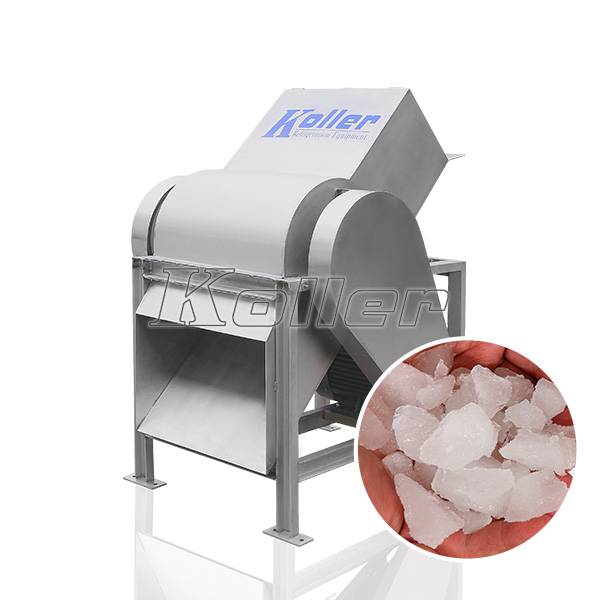
Match the Crusher to Different Ice Types
Matching crusher mechanics to specific ice geometries and temperatures prevents motor burnout, eliminates structural jamming, and preserves ice texture.
Different ice types require dedicated mechanical approaches. Solid, hard ice demands raw fracturing force, while soft, chewable formats need precision gaps to avoid turning the feed into mush.
Mechanical Matching for Dense Cubes versus Soft Pellets
Standard crushing chambers cannot treat all ice formats equally. Processing high-density blocks with mechanisms built for soft ice causes instant mechanical failure.
- High-Torque Requirements: Heavy-duty stainless steel blades and high-torque motors fracture dense, solid full-cube or gourmet ice without stalling.
- Low-Torque Adjustments: Lower-torque motors paired with adjustable-gap crushers process softer, chewable nugget and crescent ice forms efficiently.
- Motor Protection: Thermal overload protection prevents motor damage during high-load crushing cycles of large, solid geometries.
Sizing, Temperature, and Environmental Layout Constraints
System layout and physical clearances directly dictate continuous throughput. Physical sizing must accommodate the raw ice before any mechanical crushing begins.
- Hopper Clearance: Maximum hopper inlet clearances must exceed the largest dimension of the source ice to prevent bridging and jamming.
- Thermal and Drainage Management: Subcooled flake and scale ice require thermal-tolerant blades, while near-freezing cube ice requires robust drainage systems to handle rapid melting.
- Proximity and Ventilation: Crushers require positioning close to the ice storage bin and sufficient ventilation to maintain high-speed throughput.
Capacity Matching Between Ice Maker and Crusher
Match your ice crusher to peak hourly demand and storage volume rather than daily production averages to prevent costly service bottlenecks.
| Operational Need | Ice Maker Daily Target | Crusher Throughput Sizing | System Sizing Implication |
|---|---|---|---|
| Small Cafe / Low-Volume Bar | 25 to 47 kg / day | Sized to peak window, not 24-hour average | Compact setup with modest bin capacity and short burst crushing. |
| Busy Restaurant / Foodservice | 58 kg / day or more | Sustained throughput across busiest shifts | Higher-capacity crusher with storage sized to cover peak service. |
| Hotel / Large-Scale Processing | 116 kg / day or more | High duty-cycle commercial processing | Often requires dedicated installation space and stronger electrical support. |
Sizing Methodology and Peak Demand Calculations
Real-world ice demand is never a flat line. Sizing an ice production and processing system based on 24-hour averages guarantees a supply failure during busy shifts. Operators must separate ice generation rates from physical processing and storage limits to keep up with actual usage.
- Hourly Peak Focus: Calculate peak hourly service windows instead of relying on daily production averages. This identifies the absolute volume of ice you must crush and distribute during your busiest 1-to-3-hour periods.
- Safety Margin: Apply a 20% to 40% headroom buffer to handle seasonal surges, local heat gain, and handling losses. This extra volume keeps the crusher fed when ice melts faster in warm environments.
- System Separation: Separate ice maker daily production capacity from storage bin holding volume. A high-production head cannot deliver usable ice if your storage bin is too small to accumulate a buffer.
- Electrical Verification: Verify crusher electrical draws match facility circuits and support heavy duty cycles. High-capacity commercial crushers often require dedicated 20-amp lines to prevent breaker trips during heavy startup loads.
This calculated approach prevents mechanical bottlenecks. Balancing the feed rate from storage with the crusher’s hourly throughput rating ensures the motor operates under a stable, predictable load.
Commercial Scenarios and Integration Benchmarks
Matching machinery to specific business profiles ensures peak operational efficiency. Over-specifying a system wastes upfront capital, while under-specifying leads to mechanical failure, motor strain, and frozen service lines.
- Low-Volume Setups: Operations with 25 to 47 kg daily production utilize compact systems for short bursts. These units process stored cube ice quickly during prep hours, allowing the ice maker to slowly replenish the storage bin afterward.
- Mid-Sized Foodservice: Foodservice environments requiring over 58 kg daily need sustained crusher throughput. These systems handle repeated peak draws during major lunch and dinner rushes without overheating the motor.
- Large-Scale Operations: Operations exceeding 116 kg daily require high duty-cycle commercial machinery. These heavy-duty industrial setups often run near-continuously to support bulk seafood, catering, or industrial cooling processes.
Avoid common planning errors like ignoring high kitchen temperatures and seasonal customer spikes. Ambient air temperatures above standard testing conditions directly degrade the ice maker’s output, reducing daily yield by 10% to 20% right when summer demand peaks.
Designing an Efficient Ice Processing Line
Matching ice maker discharge with crusher speed and a 10% to 25% safety buffer prevents bottlenecks and maintains strict sanitation control across processing lines.
Relying on nominal ice machine ratings often leaves processing lines starved during peak hours. Real-world operations demand a calculated approach based on actual product weight and environmental variables.
- Ice Demand Calculation: We base calculations on real product-to-ice weight ratios. For seafood preservation, this means applying 30% to 50% of the product weight in ice rather than relying on generic machine harvest capacities.
- Crusher Speed Synchronization: The crusher processing speed must directly match the peak hourly discharge rate of the ice maker. Slow crushers create immediate backlogs in the storage bins, halting downstream packing.
- Safety Margin Allowance: We apply standard safety margins of 10% to 25% to the calculated daily volume. This buffer offsets ambient temperature spikes in warm climates and accounts for transport melt losses.
Balancing these three capacities prevents operators from over-crushing limited stock or stalling the packaging lines during peak vessel unloading windows.
Process Flow Integration and Sanitation Controls
Ice is a food-contact medium. Its movement through a processing facility requires a layout designed to prevent microbiological contamination while maintaining thermal control.
- Linear Material Layout: The line routes ice in a strict, single direction from water intake to dosing stations. Eliminating backtracking and cross-traffic reduces airborne contamination risks.
- Sanitation Infrastructure: Integrating clean-in-place (CIP) systems and sloped floor drainage during the initial layout phase removes standing water hazards where bacteria like Listeria thrive.
- Speed and Level Automation: Conveyor speeds synchronize with bin level sensors. When downstream packing lines slow down, the sensors automatically dial back ice delivery to prevent clumping.
Coordinating physical flow with electronic sensors keeps product temperatures consistently between 0°C and 1°C, securing cold chain compliance without manual handling.
Conveyor, Storage, and Feeding Considerations
Unsynchronized conveying and feeding choke industrial ice lines. Aligning conveyor speeds, bin geometries, and surge buffers stabilizes system throughput and prevents mechanical failure.
Conveyor Selection and Layout for Continuous Ice Transport
Conveyor design directly impacts ice quality and system uptime. Mismatched layouts create immediate bottlenecks, leading to premature melting and mechanical wear. Moving ice requires specific handling mechanics based on its form and the transport path.
- Conveyor Type Selection: Use enclosed screw conveyors for small granular ice to prevent contamination, and belt conveyors for larger block ice.
- Layout Geometry: Keep inclined belts at or below 20 degrees. Gentle slopes minimize rollback, spillage, and unnecessary energy loss.
- Speed Synchronization: Deploy variable frequency drives and sensors to match conveyor speed directly to ice harvest rates, reducing mechanical wear.
- Meltwater Control: Install conveyor skirts, scrapers, and dedicated floor drains to manage meltwater and prevent ice accumulation in conveyor pits.
Storage Sizing and Controlled Feeding Methods for Stable Processing
Decoupling ice production from crushing requires strategic storage buffers. Without correct bin geometries and surge controls, gravity feeds fail and compaction halts the line. Proper planning secures process continuity during maintenance or demand spikes.
- Buffer Sizing: Size bulk storage bins to hold at least two days of ice production. Sizing for four to five days is preferred to absorb demand spikes and maintenance.
- Bin Geometry: Design deep bins with steep outlet geometry to prevent ice bridging, compaction, and flow blockages.
- Infeed Distribution: Deliver ice evenly and perpendicularly across the full length of the crusher inlet to prevent uneven roller wear and feed blockages.
- Surge Management: Integrate intermediate surge bins with level controllers to eliminate high mass-flow fluctuations and maintain a steady feed rate.
Common Matching Mistakes to Avoid
Mismated ice makers and crushers trigger mechanical failure, ice bridging, and bacterial growth. Protect your throughput by matching peak hourly load, geometry, and utility clearances.
Sizing and Mechanical Integration Incompatibilities
Mechanical issues crop up when operators treat the ice maker and the crusher as unrelated accessories. They must function as a single, physically aligned system to prevent operational bottlenecks.
- Daily Average Sizing: Sizing the system based on average daily use rather than peak hourly crushed ice demand plus a safety margin leads to severe ice shortages during rush hours.
- Ice Type Mismatch: Matching hard ice types like gourmet or thick dice cubes with light-duty crushers accelerates motor and blade wear, causing premature failure.
- Chute Misalignment: Misaligning ice maker discharges with crusher hoppers causes ice bridging, spillage, and structural blockages in transition zones.
- Improper Product Mix: Ignoring the specific ratio of cubed to crushed ice needed results in an undersized crusher or empty storage bins.
Feeding dense, large-format gourmet cubes into a motor rated only for standard cubes or soft nuggets will jam the machinery. Always verify physical discharge heights and feed throat dimensions before anchoring your equipment.
Operational, Environmental, and Maintenance Mismatches
Even perfectly sized hardware fails if the local environment or maintenance schedules are ignored. Crushed ice melts rapidly and demands coordinated sanitation to prevent health code violations.
- Restricted Airflow: Restricting necessary airflow clearances around air-cooled condensers raises operating temperatures, lowers ice output, and strains the compressor.
- Isolated Sanitation: Treating the ice maker and crusher as separate sanitation systems allows biofilm and bacteria to build up in transition chutes.
- Inadequate Drainage: Installing inadequate drainage lines that fail to handle the faster melt rates of high-surface-area crushed ice causes stagnant pools.
- Control Board Errors: Misconfiguring control boards or physical selectors leads to unintended continuous crushing, which wears down the gear train.
A choked air condenser drops actual ice production by up to 20 percent while driving up utility bills. Run both machines on a single, synchronized sanitation routine to keep your ice clean, dry, and food-safe.
Example Configurations for Different Industries
Equilibrar la capacidad del fabricador de hielo con la tasa de trituración y el almacenamiento evita cuellos de botella térmicos y operativos en cada sector.
El sector comercial exige inmediatez. Los picos de demanda durante las horas de servicio agotan rápidamente las reservas si los equipos de generación y trituración no trabajan en sincronía técnica.
Especificaciones técnicas para el sector comercial y de servicios de alimentos
- Bares y restaurantes: Equilibramos fabricadores comerciales de 23 a 115 kg/día con trituradores de 100 a 300 kg/h para absorber de manera eficiente los picos de servicio.
- Hoteles y catering: Implementamos múltiples fabricadores distribuidos con almacenamiento central de 4 a 6 horas para soportar banquetes y eventos masivos.
- Cafeterías y locales pequeños: Integramos unidades compactas bajo mostrador (23 a 90 kg/día) y trituradores comerciales de barra con ajuste de textura fina.
En procesos industriales, el hielo funciona como un regulador térmico crítico. La precisión en el espesor y la dosificación directa determinan la calidad del producto final y la seguridad de la reacción química o del fraguado.
Dimensionamiento para aplicaciones de procesamiento industrial y construcción
- Industria cárnica y panadería: Incorporamos máquinas de hielo en escamas de alto volumen que dosifican de forma directa a las mezcladoras para regular la temperatura de la masa.
- Conservación de mariscos y pescaderías: Configuramos sistemas de producción de hielo en escamas con espesor de 10 a 12 mm para garantizar una cobertura óptima en los expositores.
- Hormigón e industria química: Instalamos sistemas de almacenamiento aislado y trituradores industriales de alta resistencia con el fin de evitar interrupciones térmicas en los procesos de fraguado o reacción.
Frequently Asked Questions
How do you match an ice crusher with an ice maker?
To match these machines in a single system, you must align ice form, hourly throughput, and water conditions. Calculate the maximum hourly ice production under realistic summer temperatures, then select a crusher with a continuous throughput that exceeds that hourly rate by a 10% to 30% safety margin. Finally, ensure the physical feed method—whether gravity chutes or screw conveyors—can handle the specific ice type without bridging or clumping.
Can one crusher work with multiple ice machines?
Yes, a single crusher can process ice from multiple machines if the combined peak output does not exceed the crusher’s maximum throughput. This configuration requires a shared conveyor or gravity feed system, a central buffer storage bin, and automated control interlocks. The controls prevent overfilling by stopping the upstream ice makers or conveyors if the crusher experiences a jam or motor overload.
Should the crusher capacity exceed the ice maker output?
Not in every scenario. Match the crusher capacity to your peak hourly demand rate rather than the daily rating of the ice maker. If you store ice in an insulated bin and crush it in batches, the crusher can have a lower daily rating than the ice maker. If you crush ice immediately after production, size the crusher to meet or slightly exceed the ice maker’s maximum hourly discharge to avoid line bottlenecks.
Can block ice and tube ice use the same crusher?
No, they require different crushing mechanisms. Block ice needs high-torque, heavy-duty crushers with wide feed openings to fracture large, dense masses. Tube ice consists of small, hollow cylinders that use high-speed granular crushers or internal breaker bars. Attempting to process block ice in a tube ice crusher will cause motor burnout, bent shafts, or structural damage.
Do I need an ice storage bin before crushing?
Yes, a pre-crushing storage bin is practically mandatory in commercial and industrial lines. It serves as a physical buffer between continuous ice making and batch or on-demand crushing. The bin decouples the production rate from the consumption rate, protects the crusher from feed surges, reduces mechanical wear, and ensures a steady, controlled flow of ice to the blades.
What conveyor options are best for moving ice to a crusher?
The main options include screw conveyors, belt conveyors, bucket elevators, and gravity chutes. Screw conveyors are ideal for short distances, tight layouts, and elevating granular ice through enclosed, hygienic tubes. Belt conveyors work best for long-distance horizontal transport across a plant floor. Bucket elevators provide efficient vertical lifts to high-level silos or dosing hoppers.
How do you avoid production bottlenecks in an ice processing line?
To prevent bottlenecks, size your entire system based on the slowest processing step. Use value stream tracking to find where ice accumulates or where equipment sits idle. Maintain a small, controlled buffer of ice before the crusher to absorb fluctuations. Schedule routine maintenance during planned downtime, and install automated level sensors to coordinate feed rates between the ice maker, storage bin, and crusher.
Final Thoughts
While piecing together mismatched, low-cost machinery might reduce upfront capital, configuring a fully synchronized ice maker and crusher system is the only way to shield your operation from mechanical failures, sanitation violations, and line bottlenecks. Investing in engineered compatibility protects your daily throughput and ensures your product remains safely chilled when ambient temperatures spike. Cutting corners on system integration inevitably leads to motor strain, operational downtime, and lost product.
Don’t guess on physical clearances or hope your power supplies will handle the load during peak shifts. We recommend sharing your production volume goals and layout constraints with our application engineers to build a balanced, automated flow. Contact our technical team today to review custom OEM options or request our complete processing equipment catalog.
