


Streamlining how to choose the right commercial ice crusher machine for your business protects your daily operational margin from high warranty claims and service bottlenecks. Sourcing incompatible hardware risks rapid motor wear and immediate health code violations during peak service windows.
This analysis benchmarks crushing equipment against high-volume industry standards. We evaluate peak 90-minute capacity requirements and stainless steel blade metallurgy to help you secure a scalable result.
Why Choosing the Right Ice Crusher Matters
Your ice crusher directly impacts peak-hour labor efficiency, product presentation, food safety compliance, and utility costs by bridging the gap between raw ice production and service.
Operational Throughput and Beverage Quality
Sizing your ice crusher machine to match physical demands prevents back-of-house delays and ensures consistent drink preparation during your busiest shifts.
- Crusher Capacity: Aligning unit capacity (typically 150 to 500+ lbs/hr) with peak demand windows prevents service bottlenecks and keeps staff focused on customers rather than waiting for ice.
- Ice Maker Integration: Matching crusher throughput with your ice maker’s daily harvest rate (ranging from 50 to 2,500 lbs) prevents ice bin overflows and eliminates slow, manual handling workarounds.
- Texture Control: Using adjustable screens and blades allows precise control over fine, medium, or coarse textures, preserving drink dilution rates and food display presentation.
Operating Costs, Food Safety, and Workplace Compliance
Beyond daily output, the physical design and material composition of your crusher dictate your ongoing operational overhead and regulatory standing.
- Melt Loss Prevention: Minimizing heat generation during the crushing cycle reduces ice melt, directly lowering overall energy and water costs.
- Hygienic Materials: Choosing food-grade, corrosion-resistant materials ensures full compliance with NSF/ANSI Standard 12 and ASTM F2432 sanitation guidelines.
- Operator Protection: Utilizing built-in safety interlocks, splash guards, and low-noise motor designs maintains a safe, compliant, and ergonomic working environment for your staff.
Define Your Ice Production Requirements
Sizing your ice setup requires auditing your peak hourly demand, adding a 30% safety buffer, and matching storage volume with adequate electrical and water utilities.
Calculate Daily Volume and Peak Demand
Your business model dictates the type of ice you need. Standard cubes, flake ice, and crushed ice serve distinct needs across beverage programs and food preservation displays. You must map these needs directly to operational schedules.
- Daily Targets: Small businesses require under 1,000 lbs daily, while high-volume commercial distribution plants need several thousand pounds of continuous output.
- Peak Shifts: Audit your busiest hours to ensure crushing equipment handles heavy cycles without causing service delays.
- Safety Buffer: Add a 20% to 30% margin to your calculations to cover rapid meltage and sudden surges in customer demand.
Sizing for average daily use instead of peak hours is the most common cause of undersizing in commercial settings. Ensure your hourly throughput rating matches these busiest windows.
Balance Storage Capacity and Infrastructure Requirements
A high-output ice machine is useless without the physical and financial infrastructure to support it. Production capacity must directly align with storage limits and available utility outputs.
- Storage Volume: Size your storage bins or cold rooms to hold at least one to two days of total production to protect against peak-hour shortages.
- Floor Space: Allocate at least 80 square meters of well-ventilated area for commercial-scale operations to prevent motor overheating.
- Utility Prep: Verify high-voltage electrical connections and purified water systems to maintain continuous, safe machine operation.
- Capital Budget: Plan for equipment costs ranging from $4,000 to $200,000 depending on your target scale of operation.
If your storage bin is too small, your machine will cycle off prematurely and limit real-world availability. Coordinate your production limits, storage capacity, and water filtration setups together as a single unified system.
High-Performance Commercial Ice Crusher Machines
Request Wholesale Pricing →
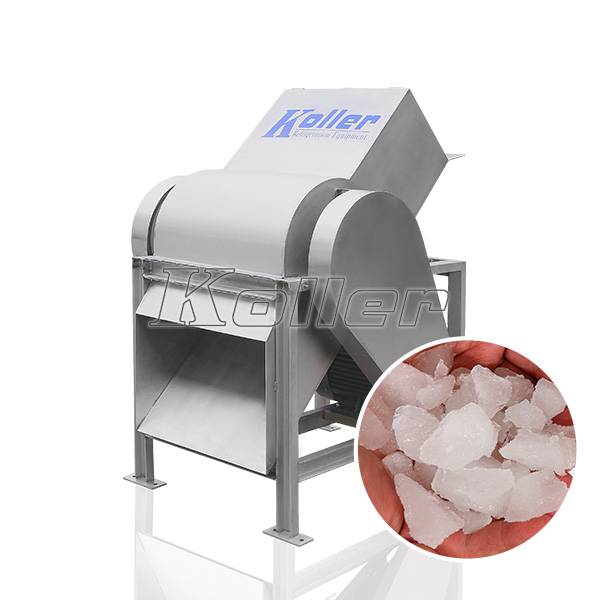
Choose the Right Machine Capacity
Size your ice crusher for peak 90-minute demand, not daily averages, and add a 20% to 30% safety buffer to prevent bottlenecks during busy shifts.
| Business Context | Sizing Benchmark | Capacity Impact |
|---|---|---|
| Full-Service Restaurant | 1.5 lbs per seat daily | Requires sizing for lunch and dinner peaks rather than average daily covers. |
| Broad Foodservice | 2 lbs per person served | Builds a quick baseline before applying the peak-use safety buffer. |
| Display & Cold Bars | 30 lbs per cubic foot | Sustains cooling loads and presentation appeal for salad or seafood displays. |
Calculate Peak Demand and Apply a Safety Buffer
Sizing a crusher based on daily ice averages guarantees slow service during your busiest hours. When the venue fills up, staff will stand idle waiting for processing cycles to finish.
- Peak 90-Minute Demand: Calculate your capacity requirements during the single busiest hour and a half of service. This stops crushing bottlenecks when your shift is under the most pressure.
- 20% to 30% Safety Buffer: Add this margin directly to your maximum peak estimate. It accommodates unexpected crowd surges, heavy summer demand, and future growth.
- Duty Cycle & Power Verification: Choose a machine with a verified duty cycle matching your workload. High-capacity crushers draw substantial current, frequently demanding a dedicated 20-amp circuit.
Apply Industry Benchmarks and Match Storage Limits
Established industry formulas help you estimate initial requirements quickly. Do not let high hourly output blind you to your physical holding limits.
- Restaurant Benchmarks: Plan for 1.5 pounds of ice per seat daily for table service, or 30 pounds per cubic foot of salad bar display space.
- General Foodservice Sizing: Budget 2 pounds per person served to establish an absolute baseline before calculating your peak shift buffer.
- Storage Bin Calibration: Pair your crusher with a matching storage bin. High hourly throughput fails if your holding area cannot absorb immediate rush demand when production lags behind.
Match the Machine to Your Ice Type
Matching your ice crusher to your ice form’s hardness and temperature prevents mechanical jams, protects blades, and ensures consistent beverage dilution or display cooling.
Ice machines produce forms with widely different densities, temperatures, and structures. Processing the wrong ice type through an incompatible mechanism ruins both the machine and the output texture.
Compatibility Profiles for Common Commercial Ice Forms
- Ice Form Specialization: Select a crusher engineered specifically for the shape and hardness of your primary ice supply, whether standard cubes, gourmet ice, nuggets, or flakes.
- Gourmet and Full Cubes: Use high-torque crushers with stainless steel components rated at or above 45 HRC to cleanly fracture dense ice without deforming the cutting assembly.
- Soft Ice Hazards: Avoid running soft nugget or flake ice through heavy-duty cube crushers to prevent immediate melting, slush formation, and mechanical jams.
- Dual-Stream Separation: Maintain separate ice supplies in premium beverage programs, reserving gourmet cubes for intact table presentation and standard cubes for your high-volume crushing line.
Hardness, Temperature, and Throughput Metrics for System Selection
Environmental conditions and power availability directly dictate how well your equipment performs during peak rushes. Sizing your system requires looking at real-world operational stress rather than ideal laboratory specifications.
- Ambient Temperature Impact: Monitor kitchen heat. Ambient temperatures around 32°C soften ice before it enters the hopper, drastically increasing clumping and melting during the crushing cycle.
- Peak Demand Calculation: Identify your busiest service windows. Calculate your maximum hourly crushing volume and apply a 1.3 multiplier to handle sudden surges and density variations.
- Duty Cycle Verification: Evaluate crusher throughput ratings at a minimum 75% duty cycle rather than basing decisions on theoretical maximum lab capacities.
- Utility and Footprint Planning: Install dedicated 20-amp circuits for high-capacity crushers. Leave 15 to 30 cm of ventilation clearance on all sides to protect adjacent ice makers from heat exhaust.
Evaluate Blade Design and Construction Materials
Ice crusher blade specifications dictate sanitation compliance, crushing efficiency, and motor lifecycle costs. Choosing correct alloys and geometries prevents premature mechanical failure and food safety issues.
Select Food-Grade Stainless Steel Alloys and Surface Treatments
Selecting the right blade material directly affects your equipment’s lifespan and compliance status. Standard water exposure quickly degrades inferior metals, leading to rust and critical food safety failures.
- AISI 304 Stainless Steel: Use this alloy as your baseline specification. It resists corrosion in standard commercial crushing environments and satisfies NSF/ETL-Sanitation standards.
- AISI 316 Stainless Steel: Upgrade to this grade for high-saline conditions. It prevents pitting in marine setups, seafood processing, and brine-heavy environments.
- Cryogenic Hardening: Apply this treatment to the cutting edges. It maintains blade sharpness over extended shifts in high-throughput bars and hotels.
- Food-Safe Non-Stick Coatings: Utilize these surface coatings to minimize ice adhesion. They reduce friction-related motor load and streamline daily cleaning tasks.
Optimize Blade Geometry, Calibration, and Wear Mitigation
Blade configuration dictates how efficiently the machine fractures ice. The wrong setup wastes energy and produces inconsistent textures that ruin drink presentation.
- Blade Profiling: Specify straight cutting edges to shave fine ice. Switch to serrated or toothed profiles to grip and break hard, irregular ice blocks.
- Multi-Wing Rotors: Incorporate these configurations to increase the cuts per revolution. They raise your hourly production and yield highly uniform particles.
- Blade Gap and Sizing Screens: Adjust these components to calibrate the output size. Tight control here reduces the mechanical work required per kilogram of crushed ice.
- Daily Maintenance Checks: Inspect the cutting edges daily for chipping or dulling. Catching wear early protects your motor from overloading and prevents product contamination.
Consider Automation and Safety Features
Automating your ice crushing and enforcing strict mechanical safety protections directly lowers labor costs, prevents employee injuries, and guarantees consistent ice texture.
Operational Automation and Texture Controls
Manual ice crushing drains staff time and introduces physical strain during peak hours. Shifting to automated processing stabilizes prep speed and ensures predictable ice output.
- Continuous automatic feed mechanisms: Motorized pusher bars and auger systems handle consistent, high-volume throughput to reduce manual strain.
- Integrated self-diagnostic controls: Internal sensors track motor temperatures and system loads to detect blockages before mechanical damage occurs.
- Adjustable texture settings: Simple dial or lever controls let operators switch easily between fine, medium, and coarse profiles without stopping the work.
Standardizing your texture settings prevents drink dilution issues and guarantees that your ice output matches your exact operational requirements.
Mechanical Safeguards and Sanitation Standards
High-speed rotating parts pose severe safety risks in a busy kitchen or bar. Investing in certified components and physical safety locks protects your staff and keeps your facility compliant with local health codes.
- Lid interlocks and emergency stops: Safety switches instantly cut power to rotating cutting parts when guards open, protecting operators from contact injuries.
- NSF-certified stainless steel: Food-grade components prevent corrosion and facilitate rapid teardown of the crushing chamber for deep sanitation.
- Ergonomic discharge configurations: Stable mounting structures and optimized discharge heights minimize spills and reduce physical fatigue during long shifts.
Selecting NSF-certified gear with tool-free disassembly ensures your team cleans the equipment regularly, removing bacterial biofilm before it contaminates the ice supply.
Installation and Maintenance Requirements
Correct site setup and disciplined maintenance schedules guarantee food safety, prevent mechanical breakdowns, and protect your commercial ice crusher investment over its lifespan.
Site Preparation and Utility Connections
Grounding your system properly and selecting a stable surface keeps the unit running smoothly. Unstable foundations cause premature bearing failures and loud mechanical vibrations.
- Stable Foundation: Place the unit on a flat, level surface to minimize mechanical vibration and prevent uneven wear on blades, augers, and bearings.
- Dedicated Power: Match electrical specs to the local supply using a dedicated, grounded circuit equipped with surge and residual current device protection.
- Hygienic Plumbing: Connect potable water lines using food-grade hoses and install a sloped gravity drain line with a 25 mm air gap to block backflow.
- Pre-Start Inspection: Run mechanical reviews, verify safety guards, and execute initial test cycles to check crushed ice consistency and noise levels.
Never skip the 25 mm air gap on your drain line. Skipping this connection invites backflow contamination, which instantly violates local health codes.
Cleaning Protocols and Preventative Maintenance
Ice is food. Neglecting your sanitation schedule turns the crushing chamber into a breeding ground for mold and biofilm, exposing your business to major liability.
- Daily Sanitation: Wipe down exterior surfaces and food-contact zones daily with food-safe sanitizers to prevent biofilm development and bacterial growth.
- Weekly Deep Clean: Dismantle and wash removable hoppers, funnels, and splash shields weekly using manufacturer-approved cleaners.
- Monthly Inspections: Inspect blades monthly for chips or dullness and check belt tension to prevent motor strain and maintain crushing efficiency.
- Bi-Annual Servicing: Schedule professional deep cleaning, descaling, and safety interlock inspections at least twice per year to meet food safety standards.
Dull blades force the motor to work harder, which spikes your energy bills and creates watery, inconsistent slush instead of crisp crushed ice.
Questions to Ask Your Supplier Before Buying
Technical Performance, Installation, and Daily Maintenance Questions
What ice types, dimensions, and hardness levels can the crusher process, and what is its verified throughput under peak-load conditions?
Commercial crushers require mechanical compatibility with the exact ice forms you process. Standard machines handle full and half cubes, while block or flake ice require dedicated designs. Hard cubes or gourmet ice demand high-durability components to prevent jamming.
- Input Compatibility: Verify if the infeed chute accepts your specific cube dimensions without bridging or clogging.
- Auger Hardness: Ensure the manufacturer uses a stainless steel auger with a hardness rating of at least 45 HRC to handle dense ice.
- Verified Throughput: Demand test data showing the continuous hourly crushing rate at a 75% or higher duty cycle, rather than short laboratory bursts.
- Peak Capacity: Size the machine for your busiest 90-minute window plus a 30% safety buffer to prevent back-of-house service bottlenecks.
- Thermal De-rating: Ask how much output drops when ambient kitchen temperatures reach 32°C, which softens ice and increases motor resistance.
What are the precise installation requirements, including dimensions, electrical parameters, drainage solutions, and compatibility with existing upstream ice makers?
Utility mismatches halt operations. Check every physical and electrical interface before signing the purchase order.
- Footprint and Clearances: Verify exact cabinet dimensions and the required side/rear ventilation spacing (typically 15 to 30 cm) to prevent motor overheating.
- Electrical Supply: High-output crushers often require a dedicated 20-amp circuit. Industrial systems may require 3-phase 380–415V power.
- Drainage and Backflow: Rinsing systems require a gravity drain line with at least a 1:40 slope, a 50 mm pipe diameter, and a physical 25 mm air gap to satisfy health codes.
- Upstream Alignment: Ensure the discharge height matches your current storage bin capacity, which should ideally run 10% to 20% larger than daily harvest rates.
Which brands and specifications are used for key components like the motor, gearbox, and cutting blades, and what safety certifications does the unit hold?
High-volume crushing environments wear down weak components quickly. Identify the exact brands and metallurgy used inside the cabinet.
- Motor & Gearbox: Request the specific horsepower (HP) or kilowatt (kW) ratings, along with gearbox torque limits and duty cycle ratings.
- Blade Metallurgy: Specify food-grade 304 stainless steel as a baseline, or marine-grade 316 stainless steel if operating in saline seafood facilities.
- Coatings and Hardening: Ask if blades undergo cryogenic hardening or feature non-stick ceramic coatings to reduce friction.
- Regulatory Marks: Verify full NSF/ANSI Standard 12 (or NSF/ANSI 2) sanitation listings and UL/ETL electrical safety certificates with active registration numbers.
What safety features, emergency stop systems, and risk-mitigation guards are built in to protect operators and ensure workplace compliance?
Rotating blades and high-torque motors represent high liability risks. Safe designs protect your staff and keep your business compliant with workplace regulations.
- Interlock Systems: A physical lid interlock must instantly cut power to the rotor when the hopper or service guard is opened.
- Two-Handed Start: Require a dual-switch or guarded control interface to keep operators’ hands completely clear of feed zones during startup.
- Overload Cutoffs: Ensure the control system includes thermal overload sensors and automatic shutdown functions for mechanical jams.
- Noise Control: Verify a certified noise level of ≤ 76 dB(A) at 3 feet to prevent hearing damage and maintain front-of-house guest comfort.
What is the recommended cleaning, sanitization, and maintenance schedule, and are replacement parts easily accessible to service technicians?
Neglected sanitization leads to biological film growth and biological inspection failures. Maintenance schedules must align with your daily operational capacity.
- Tool-Free Disassembly: Confirm the auger and cutting plates are fully removable for sanitizing in under 90 seconds.
- Daily and Weekly SOPs: Implement daily exterior sanitation and weekly deep cleans using manufacturer-approved, non-abrasive chemicals.
- Lubrication Protocols: Apply food-grade grease to shafts and bearings weekly to prevent friction wear.
- Service Proximity: Confirm that the manufacturer has certified service technicians located within 50 to 90 miles of your facility.
- Parts Warehousing: Verify that local distributors stock critical wear items like belts, seals, and replacement blade assemblies.
Commercial Terms, Warranty Support, and Supplier Verification
What does the warranty cover, who bears the labor costs for repairs, and what specific conditions will void the policy?
Do not assume standard warranty policies cover operational realities. Get explicit written boundaries on components and labor.
- Scope and Term: Insist on a minimum 2 to 3 years of full parts-and-labor coverage, with 5 years on heavy-duty motors and gearboxes.
- Labor Inclusion: Confirm the policy covers technician travel and on-site labor rates, not just replacement parts.
- Voiding Clauses: Identify triggers that cancel coverage, such as lack of water filtration, uncertified installation, or using non-approved ice forms.
What is the exact process for filing claims, handling dead-on-arrival units, and accessing technical support during emergency breakdowns?
When a crusher breaks down during a peak shift, you need immediate recourse. Establish clear communication channels and turnaround times before buying.
- Registration Window: Verify registration deadlines (often within 5 days of installation) to keep the warranty active.
- Filing Documentation: Clarify if claims require specific serial plate photos, failure videos, or professional inspection reports.
- DOA Policy: Confirm who covers return shipping and replacement logistics if a unit arrives non-functional.
- Emergency Downtime: Negotiate a loaner unit clause or guaranteed 24-hour technician dispatch for high-volume accounts.
How long has the supplier operated in the ice equipment sector, and can they provide verifiable customer references in your specific industry?
Avoid generic equipment trading companies. Choose specialist manufacturers with an established presence in commercial refrigeration.
- Sector History: Look for at least 5 to 10+ years of dedicated commercial ice equipment manufacturing.
- Reference Cases: Request 2 to 3 active client contacts operating similar high-volume businesses to verify long-term reliability.
- Authorization Status: Verify if the seller is an authorized dealer with direct factory support or an unlisted third-party reseller.
What are the realistic lead times, shipping arrangements, and policies for handling demand spikes or sourcing critical spare parts locally?
Supply chain delays can derail your opening or expansion. Force transparency on manufacturing schedules and part availability.
- Stock Status: Confirm if the specific model is in local inventory or requires overseas production and customs clearance.
- Incoterms: Specify freight terms (such as FOB or CIF) to define who owns risk and transport logistics costs.
- Spare Parts Supply: Determine if the factory packages a “critical spares kit” (extra blades, belts, and gaskets) to keep on-site.
What is the total cost of ownership, including utility consumption, ongoing maintenance, delivery fees, and available payment or financing terms?
The purchase sticker price represents only a fraction of lifetime equipment costs. Analyze utility draws, maintenance labor, and financing options.
- Operating Utility Costs: Calculate the daily energy draw (kWh) under full continuous load based on your regional commercial electrical rates.
- Maintenance and Consumables: Factor in annual expenses for filtration cartridges, replacement blades, and specialized lubricants.
- Financial Terms: Clarify payment schedules, bulk volume discounts, and availability of commercial leasing or deferred payment programs.
Common Buying Mistakes to Avoid
Sizing for averages, ignoring ice compatibility, and skipping third-party certifications will cripple your kitchen operations and balloon your long-term ownership costs.
Sizing and Operational Compatibility Oversights
Operational failures usually start at the drafting board. When you buy an ice crusher, matching the machine to your physical space and utility limits is just as vital as matching it to your peak-hour workflow.
- Peak Demand Miscalculations: Sizing the machine for average daily volume instead of your busiest 90-minute window. This mismatch creates severe operational bottlenecks when orders pile up.
- Ice Type Mismatches: Feeding hard gourmet or cube ice into a crusher rated only for softer flake or nugget ice. This strains the motor and destroys blade integrity.
- Poor Ventilation Planning: Cramming the unit into tight spaces without the required 15 to 30 cm clearances. Restricted airflow causes heat buildup and premature compressor failure.
- Utility Infrastructure Gaps: Overlooking the need for dedicated 20-amp circuits or proper gravity drainage paths with a continuous slope.
To protect your motor and maintain service speed, audit your busiest shift’s ice usage and check your electrical panel before signing a purchase order.
Financial and Long-Term Maintenance Miscalculations
Sticker price is a terrible metric for commercial food equipment. Cheap machines almost always extract their real cost through utility bills, downtime, and health code violations.
- Sticker Price Fallacy: Ignoring the 5-year total cost of ownership. Cheap units often consume more electricity and water, costing you far more over their lifespan.
- Sanitation Hazards: Buying units with complex disassembly. If cleaning takes too long, staff skip it, leading to rapid mold growth and bio-film buildup inside the crushing chamber.
- Uncertified Equipment: Choosing machines without NSF/ANSI Standard 12 or ETL-sanitation markings. This introduces heavy liability risks and health code citation dangers.
- Support Dead-Ends: Failing to verify local technician networks and regional parts stock. A broken machine with no local parts turns into an expensive paperweight during a busy weekend.
Prioritizing NSF-certified, easily disassembled stainless steel machines with guaranteed local parts support ensures long-term profitability and seamless sanitation routines.
Frequently Asked Questions
How do I choose a commercial ice crusher?
To select the right machine, match your peak 90-minute crushed ice demand—not daily averages—to the equipment’s rated throughput. Look for NSF-certified stainless steel construction, a hardened auger (at least 45 HRC), and safety features like lid interlocks and two-hand start controls. Ensure the unit operates quietly (below 76 dB(A) at 3 feet) if you place it near customers, and verify that your electrical circuits support the required voltage and amperage.
What capacity do I need?
Calculate your hourly peak demand rather than relying on daily averages. For standard food service, estimate about 1.5 to 2 pounds of ice per customer daily. If 40% of your drinks use crushed ice, multiply your peak guest count by the ice weight per serving and add a 30% safety buffer. This calculation ensures your crusher keeps pace with your busiest rushes without bottlenecks. For cocktail-heavy bars, plan for up to 3 pounds of ice per customer.
Can one machine crush different ice types?
Many commercial crushers process multiple ice forms like standard cubes, half-cubes, and blocks, but they must have the proper feed size and cutting mechanisms. Harder, dense cubes put more mechanical stress on blades than soft nugget or flake ice. If your business requires fundamentally different ice types for distinct uses, such as drinks and seafood display, installing separate specialized machines prevents motor strain and ensures consistent textures.
Should I choose automatic or manual feeding?
Choose automatic feeding if you run a high-volume operation requiring a continuous flow of crushed ice. Automatic systems deliver steady ice volume, reduce physical labor, and minimize hand contact near the hopper. Select manual feeding for lower-volume or batch-oriented setups where staff can easily load the hopper as needed, which lowers upfront equipment costs and simplifies daily maintenance.
Which blade material lasts longest?
Hardened martensitic stainless steel (such as 420 or 440C) offers the best balance of corrosion resistance and edge retention for standard commercial ice crushing. For heavy-duty industrial processing or mixed-ingredient applications, cold-work tool steels like D2 or blades with tungsten carbide tips provide the highest wear resistance and longest service life.
How often should blades be sharpened?
In commercial food service, operators typically replace blades every 2 to 3 months or after processing 2,000 to 3,000 servings, rather than sharpening them. If your manufacturer permits sharpening, schedule it every 40 to 80 operating hours. Replace blades immediately if you notice uneven ice textures, increased noise, or micro-cracks during weekly inspections.
Final Thoughts
While generic, low-cost crushers offer tempting upfront savings, investing in NSF-certified, AISI 304 stainless steel equipment with 45 HRC hardened components is the only way to safeguard your operations against peak-hour motor failures and sanitation violations. High-volume environments require reliable, high-torque performance that cheap alternatives simply cannot sustain over demanding multi-shift workloads. Securing a heavy-duty system now eliminates the high maintenance costs and service delays that erode your daily profitability.
Don’t guess on equipment durability—verify it. We recommend reviewing our technical catalog or scheduling a consultation to match our high-capacity systems to your specific daily layout. Contact our engineering team today to discuss your OEM specifications and custom sizing requirements.
